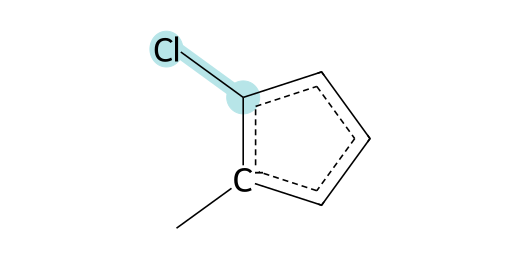
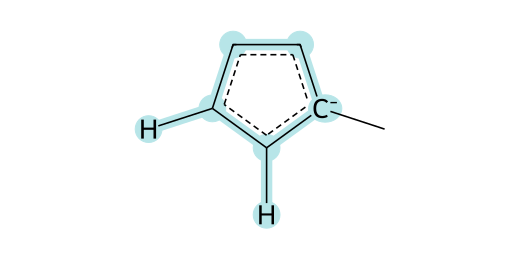
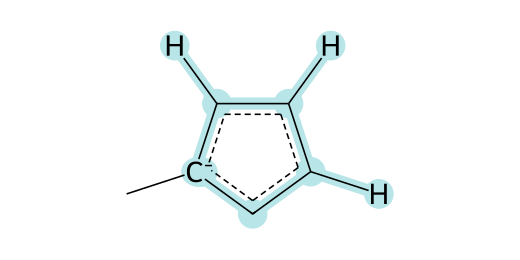
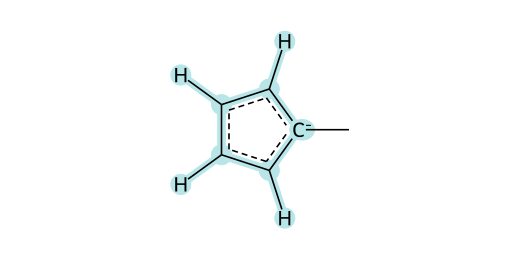
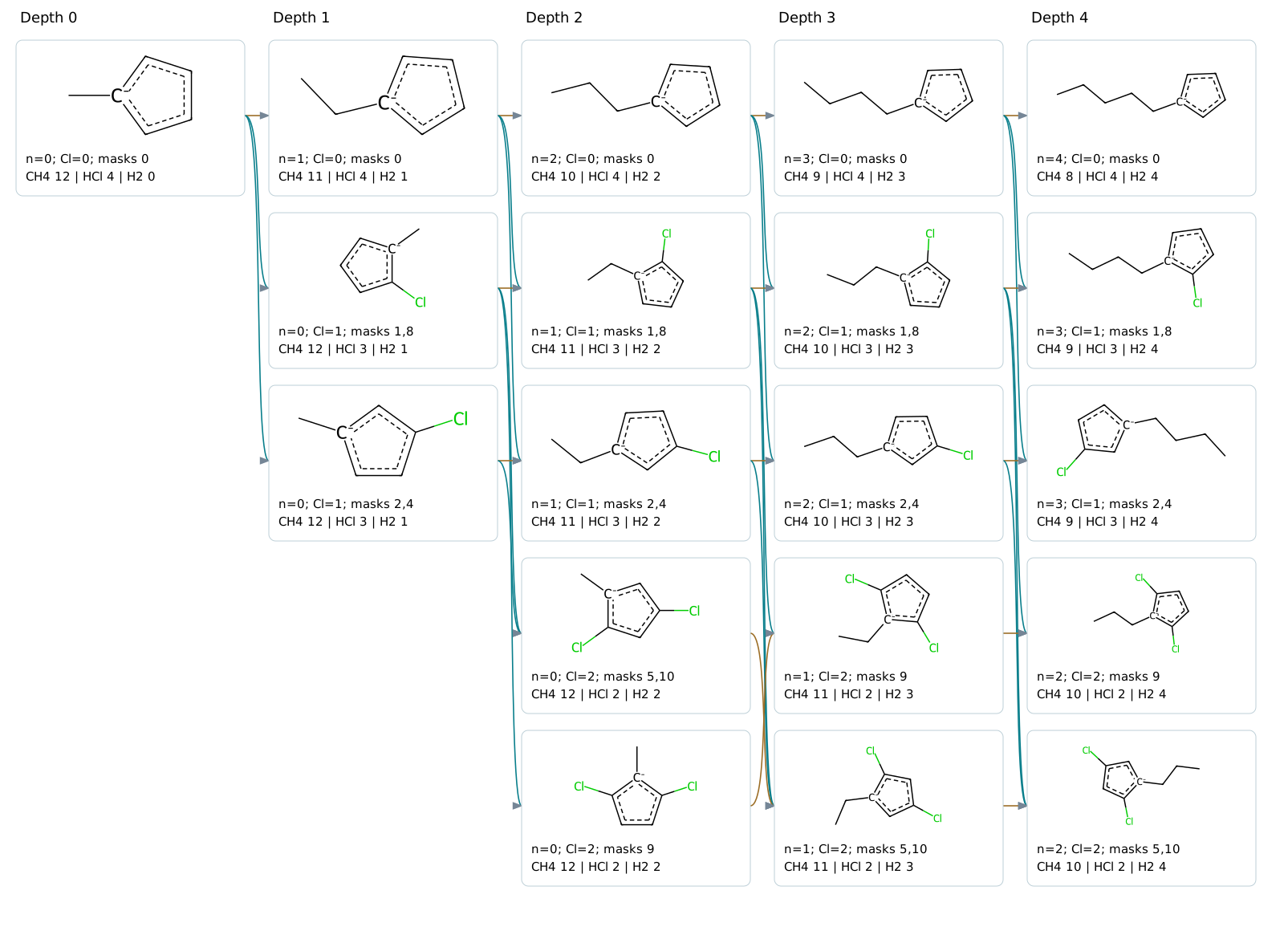
A growing tail gives an infinite graph family. A ring site reacts only if no neighbouring neutral ring carbon bears chlorine.
1 · Rules & state space
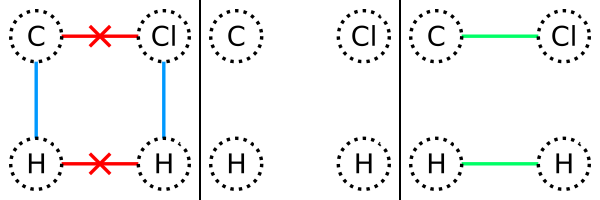
All five ring bonds remain aromatic (label :, drawn with dashed inner lines). Chlorination changes only the substituents. One C–H bond becomes C–Cl: one HCl is consumed and one H₂ produced. Removing the NAC changes only the neighbour test. The separate tail-growth rule is identical in both models.
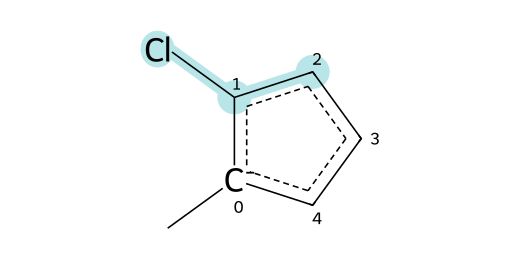
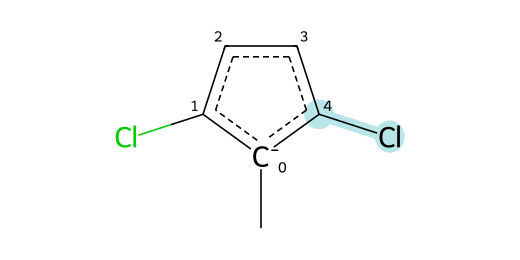
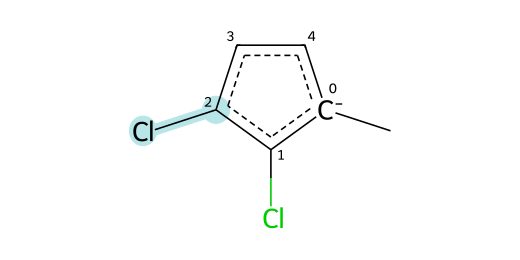
Cl at site 1: the highlighted neighbour test blocks site 2.→Site 4 can react in both models.Site 2 can react only without the NAC.
Follow actual rule applications
Selected molecule, inventory and derivations
Complete mixture states generated by MolFoundry rule application, grouped by molecular isomorphism. Arrows show possible transitions, not stochastic multiplicities. Depth counts reactions, including tail growth.
2 · Inputs & semantics
NAC: not exists(selected C : neighbouring C − Cl). This condition applies to each selected match. The shared aromatic-degree predicate restricts the selected C to the ring.
One charged five-carbon ring, four H/Cl sites, an arbitrary finite linear alkyl tail and arbitrary finite CH₄/H₂ pools; HCl = 4 − Z. Per-match factors: chlorination 1; growth 1/144, cancelling 3! × 4! labelled-hydrogen permutations. A stylized net-rule model, not a validated chemical mechanism.
With the NAC, Z discovers P1, P2 and P3. Without the NAC, Z alone suffices. These auxiliary positive patterns are generated from conditional composition.
The finite event model is closed in both variants. No closed expectation ODE is derived here. Growth has zero jump on the discovered counts.
With NAC
Rate / κ
Jump
-P3*Z + 4*P3
ΔZ=+1, ΔP1=-1, ΔP2=-2, ΔP3=-2
-P3*Z + 4*P3
ΔZ=+1, ΔP1=-1, ΔP2=-1, ΔP3=-2
-2*P2*Z + 8*P2 + 2*P3*Z - 8*P3
ΔZ=+1, ΔP1=-1, ΔP2=-1
-P1*Z + 4*P1 + P2*Z - 4*P2
ΔZ=+1, ΔP1=-1
Generator identities
G Z = -P1*Z + 4*P1 - P2*Z + 4*P2
G P1 = P1*Z - 4*P1 + P2*Z - 4*P2
G P2 = 2*P2*Z - 8*P2 + P3*Z - 4*P3
G P3 = 4*P3*Z - 16*P3
Without NAC
Rate / κ
Jump
Z**2 - 8*Z + 16
ΔZ=+1
Generator identities
G Z = Z**2 - 8*Z + 16
5 · Initial states
Each start is concentrated on the listed coordinate vector.
Rule
Initial coordinates · Unchlorinated
With NAC
Z=0, P1=2, P2=2, P3=2
Without NAC
Z=0
Rule
Initial coordinates · One chlorinated site
With NAC
Z=1, P1=1, P2=1, P3=0
Without NAC
Z=1
Rule
Initial coordinates · Blocked free pair
With NAC
Z=2, P1=0, P2=0, P3=0
Without NAC
Z=2
6 · Dynamics
Solid teal: with NAC; dashed red: without. Mean and variance come from the generated event model's finite forward equations. “Blocked” means no further chlorination is possible although free ring sites remain. Tail growth may continue.