1 · Rules & state space
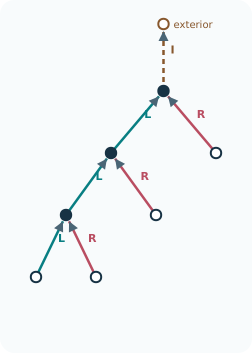
Tree growth and multiplicities
All planar trees through three insertions. A label ×m means m distinct rule matches reach the same tree; the transition rate is mκ. Select a tree to open its incidence graph in MolFoundry.
Inspect individual trees
2 · Inputs & semantics
Six rules and their graph language
Finite rooted planar full binary trees, with an exterior stem. I/L/R edge types encode the root, left and right child incidences. The six DPO rules implement the insertions of the SqPO source model on this language; deleted edge-nodes have exactly their matched incidences.
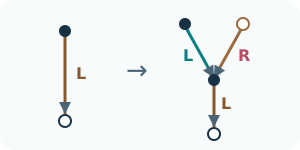
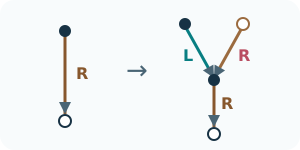
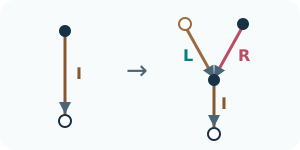
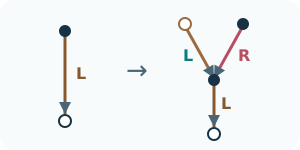
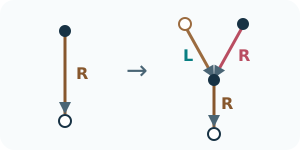
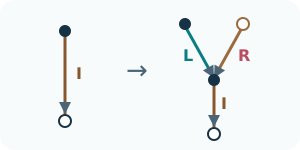
The pictures show tree insertions; the links open the DPO rules in MolFoundry.
3 · Observable discovery
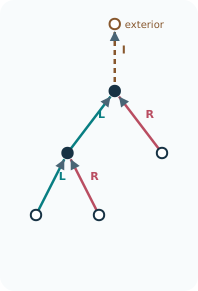
Discovered patterns and composition steps
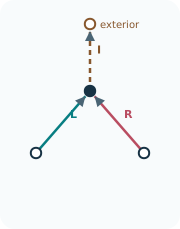
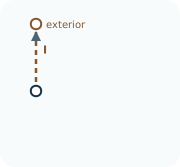
The drawings are minimal tree witnesses; each coordinate sums three typed-stem identities. The Pk labels describe the discovered graph shapes.
4 · ODE & pJC
Seed P3 → discovered P2, P1, E. The four-dimensional expectation system closes. Full event partition ↓
| Derivative | Computed right-hand side | New coordinate |
|---|---|---|
| d E[P3]/dt | κ E[-4 P3 + 4 P2] | P2 |
| d E[P2]/dt | κ E[-2 P2 + 3 P1] | P1 |
| d E[P1]/dt | κ E[2 E] | E |
| d E[E]/dt | κ E[4 E] | — |
Full event partition
The full event partition additionally uses the counting identity N(r,s)=P_(r+s). The expectation ODE follows from composition and tree-count reduction.
| Class | Δ(E,P1,P2,P3) | Rate / κ |
|---|---|---|
| J0 | [2, 1, 0, 0] | 2*E - 3*P1 + 2*P2 - P3 |
| J1 | [2, 1, 1, 0] | 3*P1 - 6*P2 + 3*P3 |
| J2 | [2, 1, 1, 1] | 4*P2 - 3*P3 |
| J3 | [2, 1, 0, -1] | P3 |
5 · Initial states
Start from one leaf and its exterior stem: E=1 and P1=P2=P3=0. All six rules share κ, called rho in the input.
6 · Dynamics
Numerical integration of the generated linear coefficients; no finite-state truncation.
Condition on the number of insertions
Here n is the number of insertion events, not elapsed time. These distributions propagate the generated event weights with exact integers.