1 · Rules & state space
Each repeat carries the same carbonyl side chain. Q0/Q1/Q2 differ in which C–C bond closes its small ring. Condensation rules insert a free capped repeat into the backbone.
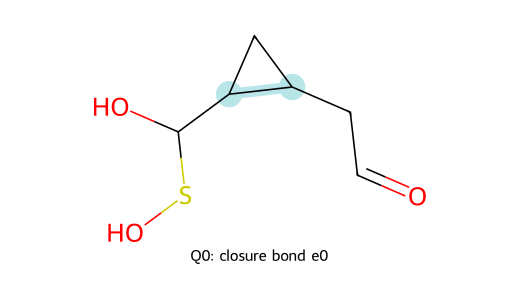
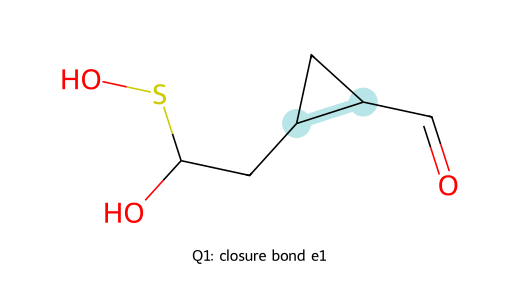
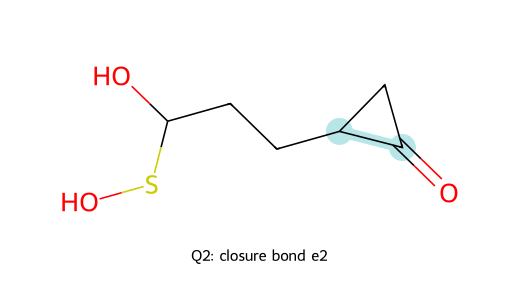
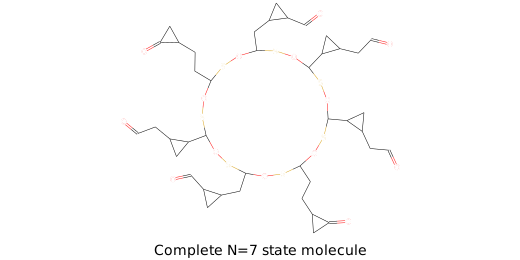
Orange marks the closure bond in each capped fragment. The full state is a macrocycle:
Fifteen DPO rules
Six rules convert site states, six exchange unequal neighbours, and three enlarge the ring by consuming a precursor and releasing water.
base_10 · Q1Q0 → Q1Q1 base
unconditional neighbour rule. Atom map and all transferred H atoms are explicit.
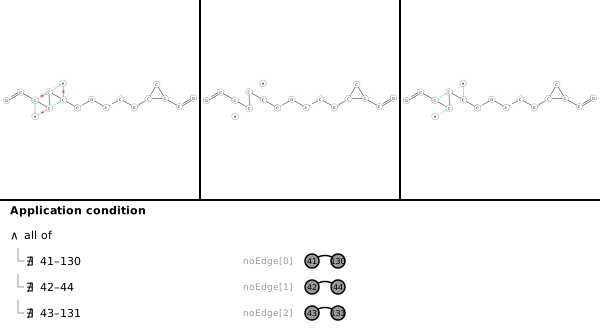
base_21 · Q2Q1 → Q2Q2 base
unconditional neighbour rule. Atom map and all transferred H atoms are explicit.
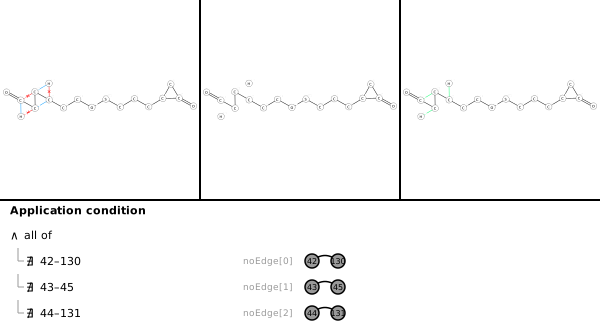
base_02 · Q0Q2 → Q0Q0 base
unconditional neighbour rule. Atom map and all transferred H atoms are explicit.
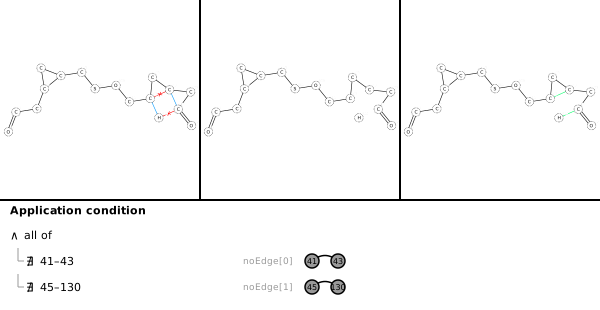
guard_10_not1 · Q1Q0 → Q1Q1 NoEdge
active condition on unchanged probe: NoEdge(e1) ⇔ probe ≠ Q1. Atom map and all transferred H atoms are explicit.
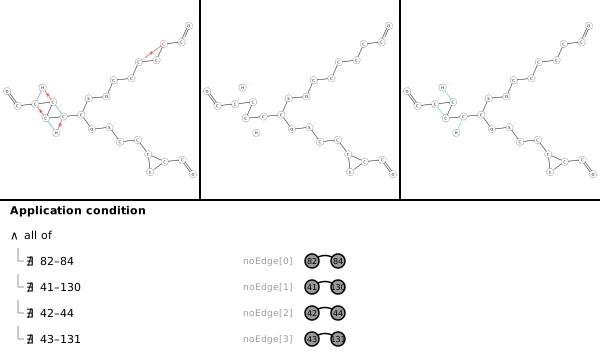
guard_21_not2 · Q2Q1 → Q2Q2 NoEdge
active condition on unchanged probe: NoEdge(e2) ⇔ probe ≠ Q2. Atom map and all transferred H atoms are explicit.
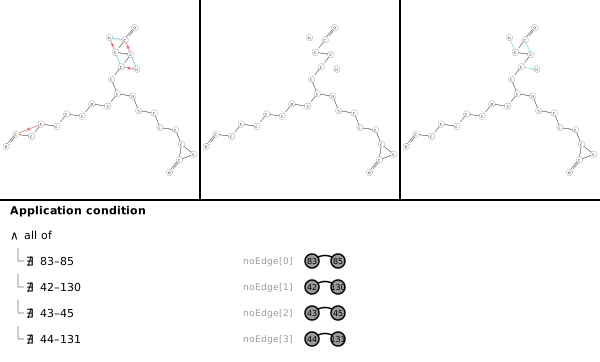
guard_02_not0 · Q0Q2 → Q0Q0 NoEdge
active condition on unchanged probe: NoEdge(e0) ⇔ probe ≠ Q0. Atom map and all transferred H atoms are explicit.
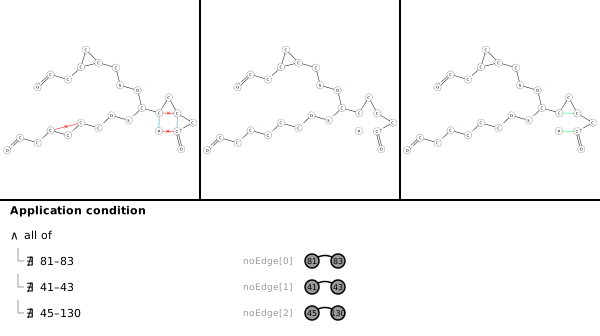
swap_01_to_10 · Q0Q1 → Q1Q0 mixing
symmetric neighbour exchange; no one-site population change. Atom map and all transferred H atoms are explicit.
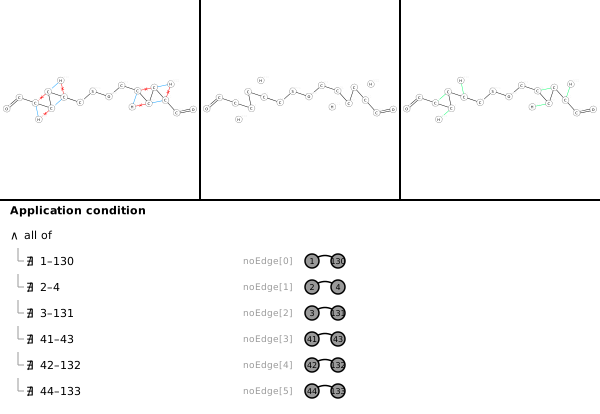
swap_10_to_01 · Q1Q0 → Q0Q1 mixing
symmetric neighbour exchange; no one-site population change. Atom map and all transferred H atoms are explicit.
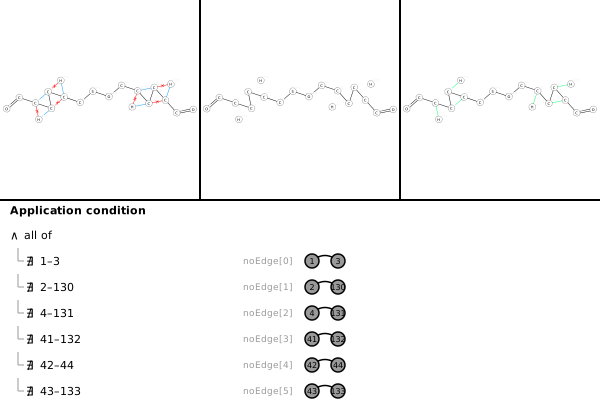
swap_12_to_21 · Q1Q2 → Q2Q1 mixing
symmetric neighbour exchange; no one-site population change. Atom map and all transferred H atoms are explicit.
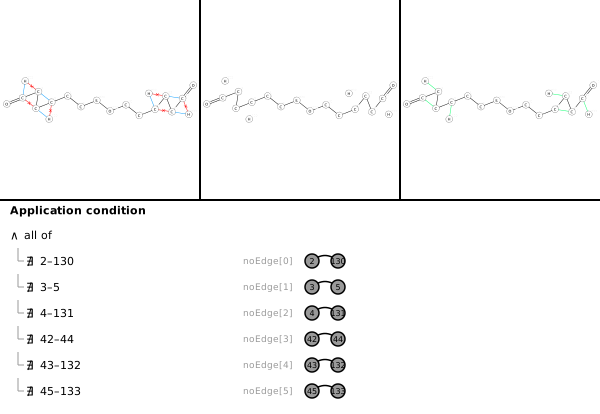
swap_21_to_12 · Q2Q1 → Q1Q2 mixing
symmetric neighbour exchange; no one-site population change. Atom map and all transferred H atoms are explicit.
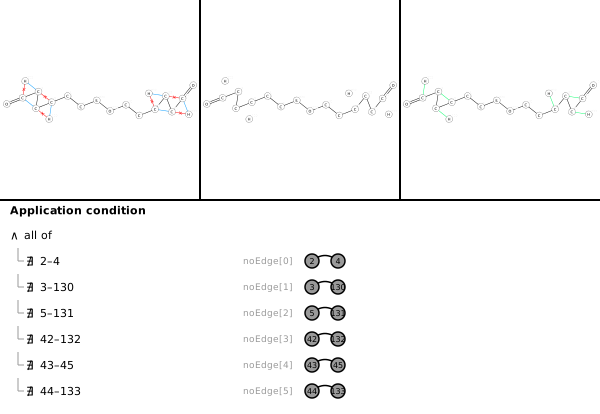
swap_20_to_02 · Q2Q0 → Q0Q2 mixing
symmetric neighbour exchange; no one-site population change. Atom map and all transferred H atoms are explicit.
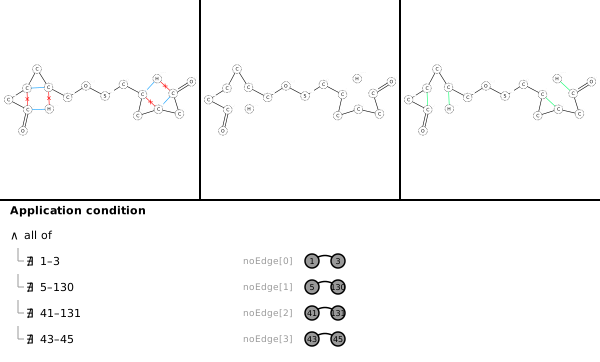
swap_02_to_20 · Q0Q2 → Q2Q0 mixing
symmetric neighbour exchange; no one-site population change. Atom map and all transferred H atoms are explicit.
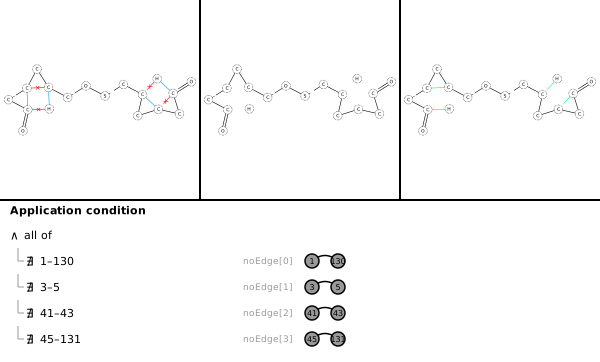
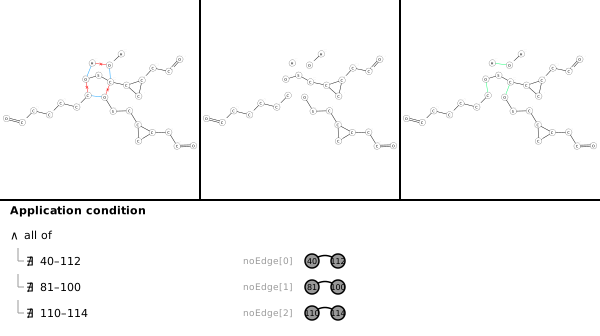
grow_copy_0 · ring-Q0 + M0 → ring-Q0Q0 + H₂O growth
state-templated precursor insertion; N grows by one and mapped water leaves. Atom map and all transferred H atoms are explicit.
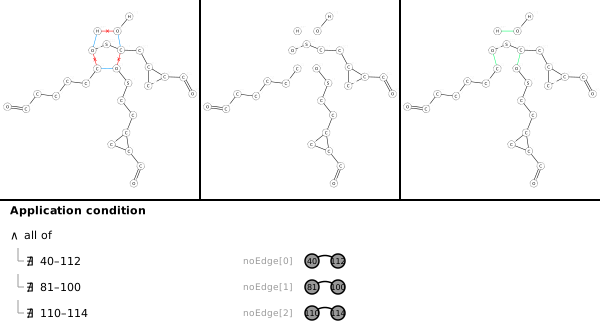
grow_copy_1 · ring-Q1 + M1 → ring-Q1Q1 + H₂O growth
state-templated precursor insertion; N grows by one and mapped water leaves. Atom map and all transferred H atoms are explicit.
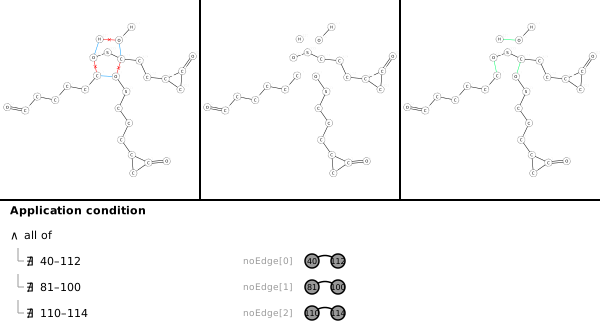
grow_copy_2 · ring-Q2 + M2 → ring-Q2Q2 + H₂O growth
state-templated precursor insertion; N grows by one and mapped water leaves. Atom map and all transferred H atoms are explicit.
State-space expansion · initial N₀=7
Expand the displayed molecule by local rearrangements and growth steps. Cyclic rotations are identified; at most eight new states are shown per layer.
States and rule applications
Transitions use the exact word representation of the checked DPO rules. Only the displayed expansion is bounded; ring growth can continue.
These atom- and valence-preserving net reactions are a structural benchmark, not a proposed elementary mechanism.
2 · Inputs & semantics
Queries: Q0, Q1 and Q2 count the three local bond configurations. The language contains one oriented ring of arbitrary size N ≥ 7 and a chemostatted precursor supply.
DPO transitions depend on neighbouring sites and absence of specified bonds. Growth inserts a like-typed repeat; ring size is unbounded.
3 · Observable discovery
Starting from Q0, Q1 and Q2, discovery introduces pair counts, triples and longer words. Orange highlights one match in an N=7 molecule.
Discovery trace
4 · Closure status
Linear closure unresolved: 39 counts remain pending after 18 expansions.
pJC unresolved: one-site counts do not determine neighbour-dependent activities. No closed finite event model was obtained.
5 · Initial states
The state expansion starts from Q0021021, a seven-site ring. The approximate dynamics start from fractions (0.72, 0.14, 0.14) and N₀=7, with a product distribution for longer words. These fractions do not specify a unique graph.
6 · Dynamics
Approximation. R1/R2/R3 retain words up to length 1/2/3 and approximate the remaining correlations at the boundary.
r sets the cyclic rearrangement rate, g the guarded rate, m the neighbour-exchange rate and β the growth rate.
Initial state and comparison settings
R1: damped oscillation
Fractions over time
Phase portrait · Q0 versus Q1
Growing observable counts N·uᵢ
Stochastic trajectory and correlations
Finite ring · stochastic trajectory
Structural correlation C10
Selected approximate ODE
Loading generated hierarchy…
One-site equations and R1 linearization
The equal-fraction R1 eigenvalues are −g/6 ± i(r/√3 + g√3/6). State-copy growth leaves the normalized fractions unchanged.